Travel CRM vs Excel Spreadsheet: Which One Saves More Time?
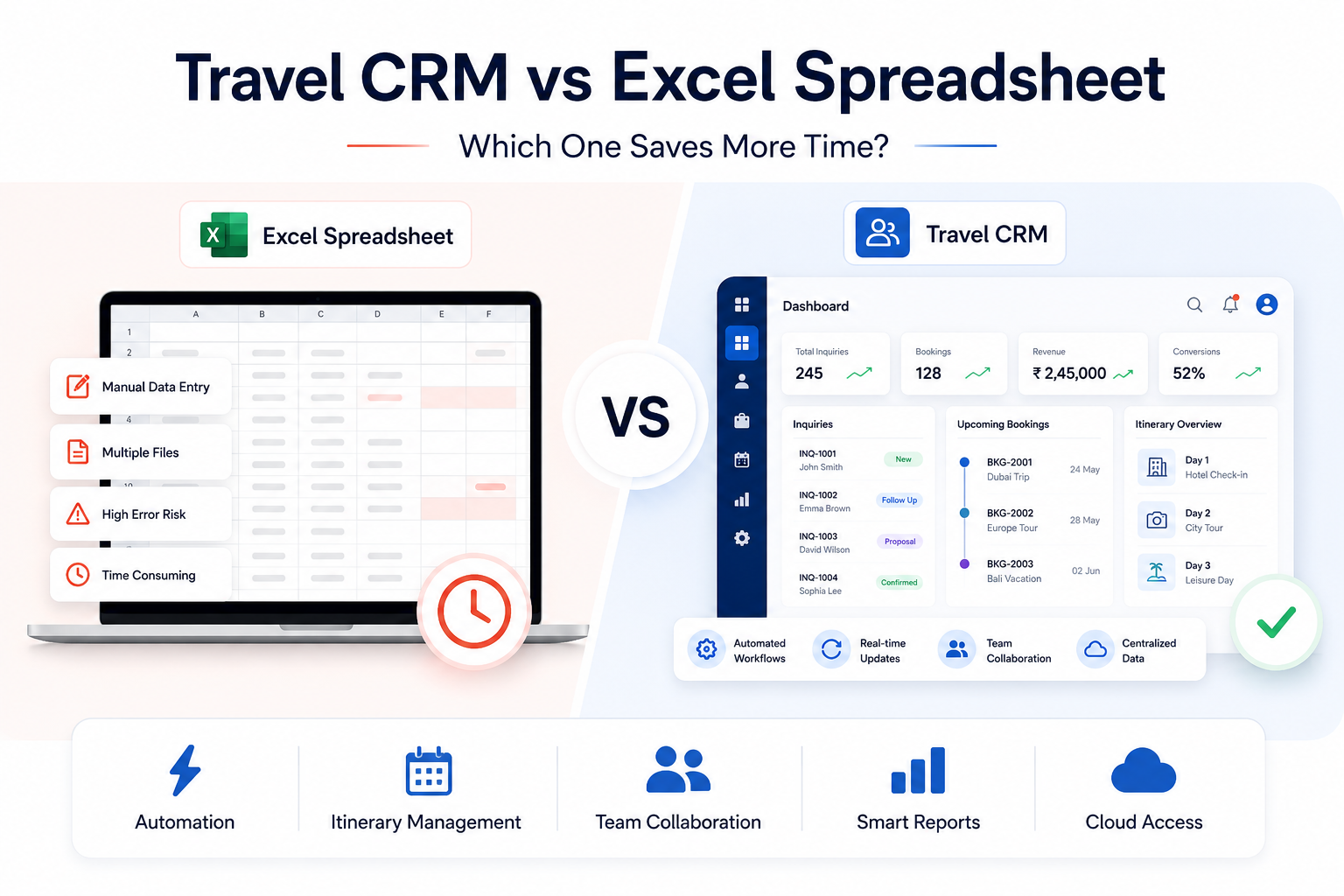
The travel business is based on efficiency, accuracy, and coordination. Travel managers deal with various tasks on a daily basis, such as making reservations and keeping track of client demands and itineraries, as well as communicating with vendors. When the operation gets bigger, it means that managing information gets more complicated.
Here arises the discussion between travel CRM vs Excel spreadsheet becomes crucial. Although spreadsheets have always been a popular tool for data management, CRM solutions tailored for the travel industry are gaining popularity now.
Which of these tools saves more time? Let us break it down for better understanding.
Understanding the Basics: CRM vs Spreadsheet
The question of Travel CRM vs spreadsheet essentially concerns itself with three aspects: functionality, automation, and scalability.
Travel CRM refers to the Excel spreadsheet application and is simply an application where one can store and organize data using columns and rows. While the tool is versatile and easily accessible, it necessitates constant effort and manual management.
In turn, Travel CRM (Customer Relationship Management system) is a specialized type of software intended for automation. It helps store all client information in one location and manage all operations, bookings, and communications more effectively.
Though both options can be used to store data, their main difference is in helping users manage time more effectively.
Time Management: Manual vs Automated Workflows
One of the most time-consuming parts of using Excel is manual data entry, in which each client, booking change, itinerary change, and payment status must be manually entered and updated.
This results in:
- Repetitive work.
- Increased chances for human error.
- Time wasted cross-checking data.
These issues become obsolete due to automation with the help of a Travel CRM. The process of creating itineraries, booking confirmations, and reminders; all of this becomes automated.
With the use of services such as Track Itinerary, these routine processes become minimal. Thus, travel experts will be able to concentrate more on their clients than on routine operations.
CTA: Stop wasting hours on spreadsheets. Switch to Track Itinerary.
Data Organization and Accessibility
An excel spreadsheet is prone to becoming disorganized very fast, particularly where large amounts of data are involved. This may cause confusion, duplication of data, or even loss of data due to the use of various sheets, tabs, and even different versions.
Locating information about particular clients or bookings can consume up to several minutes if the document is not well-organized.
The Travel CRM provides an efficient way of organizing data into one single document that can be easily searched.
It thus provides a very good alternative to an Excel spreadsheet for travel companies.
Collaboration and Team Efficiency
Where there is a booming travel business, there are usually many team members who require access to the data that exists in that particular business. With regard to excel, there may be difficulties where it is used in many teams.
Some of the difficulties experienced include:
- Data overwritten
- Unsure which file version is the current one
- Failure to collaborate effectively
Travel CRMs address this issue through cloud computing, which provides real-time updates to users from anywhere. Many users can perform tasks together, without the danger of losing information or duplications.
This boosts employee efficiency by saving countless hours that would have been wasted on fixing mistakes.
Automation of Itinerary Management
Creating manual travel itineraries in Excel takes up a lot of time. An itinerary must be formatted, edited, and customized for each and every client.
Using a Travel CRM makes things easier by providing pre-designed templates along with automatic itinerary creation software. Software such as Track Itinerary allows travel professionals to make, customize, and share itineraries in minutes.
Moreover, any modifications that have been made will be instantly updated, which will eliminate the need for manual modifications.
This is one of the most significant travel CRM benefits, particularly for companies that have a lot of bookings.
Client Communication and Follow-Ups
Communication with clients must be maintained constantly in the travel business. When using Excel, there is no communication tool provided, and thus you have to use other means such as emails.
Managing all your conversations, follow-ups, and preferences from different clients will become fragmented and time-consuming.
A Travel CRM combines various communication functions where you can:
- Make automated emails and notifications.
- Manage the interactions of your clients.
- Arrange follow-ups.
- Communicate personally.
It will not only save your time but will improve the customer’s experience as well.
Error Reduction and Accuracy
Manually entering data using Excel makes errors more possible. A single error involving dates, prices, or reservations could cause a big problem, such as dissatisfied customers and losses. Just a single misalignment of travel dates or a hotel reservation would ruin a whole itinerary, making the team waste extra hours fixing that mistake.
Other issues with spreadsheets include the absence of real-time data validation. Mistakes may go undetected until they cause difficulties, since they usually are not noticed at the point of entry but when a problem occurs because of them. This results in inefficiencies piling up and higher workload.
Travel CRM software can reduce such risks by means of:
- Machine-based data input
- Pre-defined workflow
- Validity testing
Furthermore, the use of CRM software ensures the consistency of data across all modules. This means that once booking data is changed, it will be automatically displayed in itinerary, invoice, and client communication. Thereby, it eliminates any duplications and possible conflicts.
The reduction in error saves time that is wasted correcting mistakes and dealing with customer complaints. Most importantly, however, it enables an organization’s team to work with confidence knowing that the information they have is current and correct.
Scalability: Growing Without Chaos
Excel is useful for small businesses, but when your business starts to grow, it gets harder to cope.
Using Excel to manage hundreds of customers, bookings, and trips may cause:
- Slower performance
- Greater complexity
- Mismanagement
CRM for Travel can grow alongside your business. If you have 10 customers or 1,000, the CRM will remain organized and efficient.
Thus, using CRM in a travel software comparison makes more sense since it can help your company expand in the future.
Reporting and Insights
Excel depends on manual work for report generation. Creating formulae, graphs, and dashboards becomes an issue because it is time-consuming and can cause mistakes.
CRM for travel includes analysis and reporting features, which give instant insights into:
- Sales results
- Bookings dynamics
- Consumer behavior
- Earnings tracking
Such information helps to make well-informed decisions fast and improve business strategy.
Security and Data Backup
Data security is yet another vital point to consider. The Excel files can be lost, damaged, or accessed by the wrong individuals.
The travel CRM solutions provide the following services:
- Data security in the cloud
- Basic back-ups
- Access control
This will ensure that the data is secured and can be recovered easily in case of any damage.
Cost vs Time: What’s the Real Trade-Off?
Most companies refrain from migrating from Excel as a result of costs. Spreadsheets are considered “free,” but the actual cost is tied up in the effort it takes to manage them.
Taking into consideration:
- Timing involved in manual processing.
- Time wasted in mistakes.
- Inefficient communication and collaboration.
The cost of using Excel is much higher compared to the investment that a Travel CRM system demands.
Through increased efficiency and improved customer experience, a CRM system yields much more returns than investment.
Final Verdict: Which One Saves More Time?
As for comparing travel CRM vs Excel spreadsheet, the decision is obvious; the former saves a lot of time.
While Excel can serve as a good place for storing information, it is not able to automate processes or scale. Travel CRMs, including products like Track Itinerary, are meant to manage complex business processes in the travel sector.
With automation, centralization of data, better collaboration, and timely insights, there is no need to spend time on manual operations anymore.
Conclusion
In such a highly competitive environment, where the efficiency of services affects clients’ satisfaction directly, you will not be able to progress using outdated technologies such as Excel.
The transition to Travel CRM software does not mean the mere update of your technical capacities but also getting some spare time and minimizing the stress of working under pressure in order to concentrate on the main thing, offering outstanding travel opportunities.
If you are working with numerous spreadsheets now, maybe you should reconsider your strategy. The thing is that while you are able to do it, maybe you shouldn’t.
Instead, CRM tools like Track Itinerary would be a good choice.