Common Mistakes Travel Agencies Make While Managing Customers
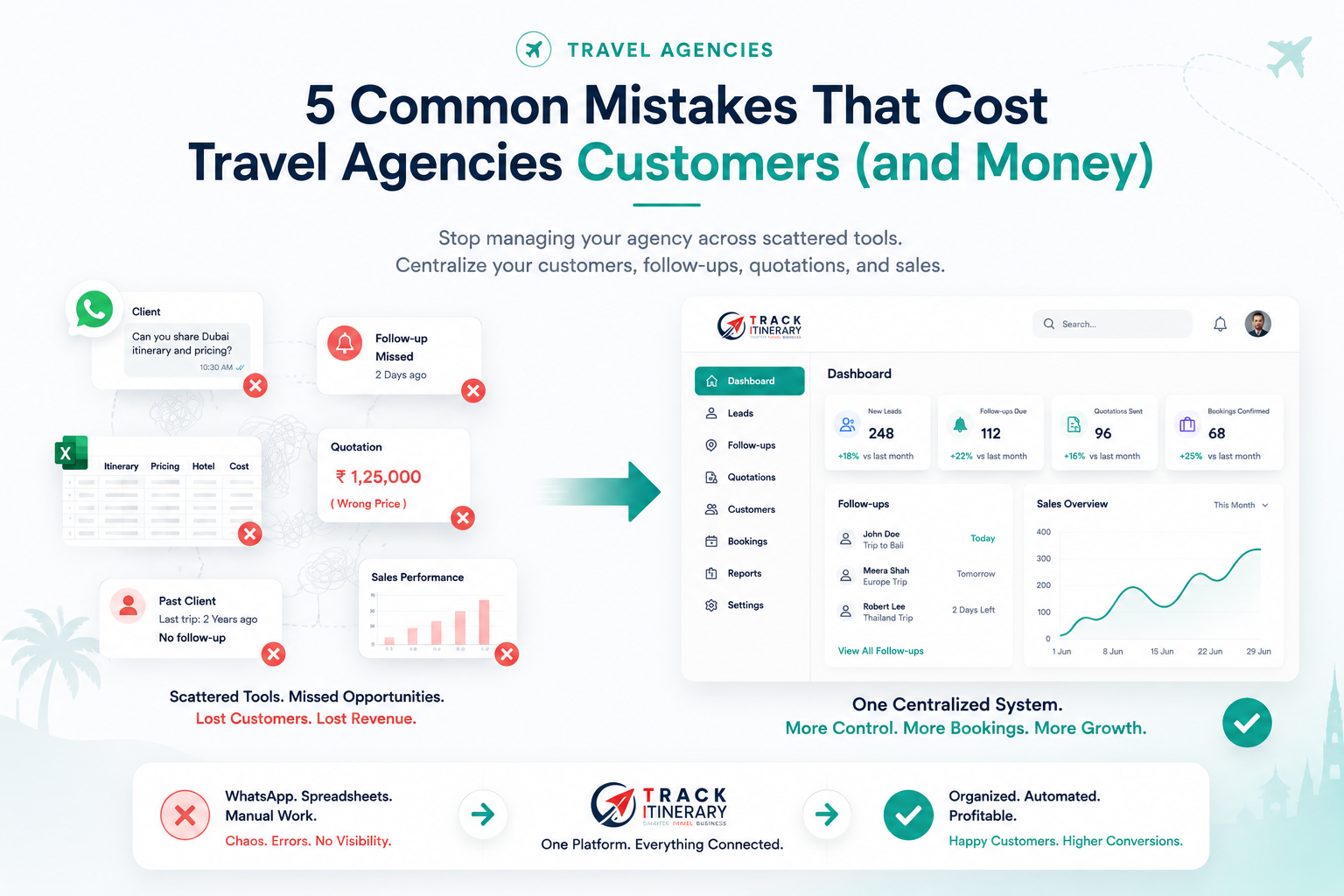
Being in the travel business is no longer associated only with offering attractive holiday packages. You are expected to give personalized service, be prompt, and communicate well at each step of the trip. However, the majority of travel agencies find themselves dealing with issues they are not even aware of; these problems are usually due to certain mistakes in travel agency management.
With the increasing customer demands, the competition becomes fiercer every day, and any tiny mistake could prevent you from getting far. Miscommunications, inefficient tracking systems, and other small issues may turn into travel agency problems in the future, consuming both your time and money. Let us have a look at some of the most common mistakes and their prevention.
Mistake 1: Relying on WhatsApp memory instead of a database
Most travel agents use messaging to handle their clients' details and preferences as well as discuss trips with them. This method seems to work well but poses a serious business risk as important discussions are lost, the preferences of the clients are not remembered, and there is no systematic way to access the information.
This method reduces customer management efficiency since the agents cannot base their decisions on the data but only on their memories. Also, in case one of the agents leaves or the agent loses his/her phone, all the data will be lost immediately. In addition, managing several clients at once is problematic and increases the likelihood of mistakes and delays.
All information, from preferred mode of transportation to past booking history, will be captured using a database or CRM. This will not only help increase efficiency but will also add a professional touch to the whole process.
Mistake 2: No systematic follow-up process
One of the major sources of revenue leakage for the travel agency is a lack of a follow-up mechanism. Most potential customers express interest in making bookings, ask for itineraries, and become unavailable afterwards. In the absence of a proper follow-up strategy, travel agents tend to miss out on following up with their prospects or make sporadic attempts.
The follow-up mistakes result in missed opportunities even when an initial inquiry is promising. Potential customers these days shop around from different agencies, and the one that does a follow-up at the right time wins.
A well-organized method that includes reminders, notifications, and defined stages of follow-up can help to increase conversions dramatically. Rather than pursuing leads haphazardly, an agent can develop a well-defined and professional process of communication which engages the prospect until booking is made.
Mistake 3: Sending wrong pricing due to manual errors
Pricing mistakes are more frequent than most agencies realize. Whenever quotes are generated manually through spreadsheets or pre-formatted documents, there is always a possibility of inaccurate computation, wrong rates, or lack of inclusions.
These quotation errors can immediately ruin trust. Overpricing can push potential clients away while underpricing would result in monetary loss on the part of the agency. Any small mistakes give off an impression of being unprofessional.
Automation of quotations through standard pricing inputs eliminates these risks considerably. It enhances accuracy, consistency, and quicker generation. Thus, enabling agents to concentrate on selling rather than cross-checking figures.
Mistake 4: Ignoring past clients for repeat business
The agencies tend to concentrate solely on new clients while ignoring those they have already provided services for, which is not wise since repeat customers are always more profitable.
If the agency lacks a system that records previous contacts, the client will not be contacted by the agency for any future trips, special offers during seasons, and other such reasons. Gradually, this will make retention difficult for the agency.
Having a database of the clients is crucial for the agency because it allows keeping in touch with old customers who can be persuaded to use the agency again and again.
Mistake 5: No visibility into sales team performance
Many times, in travel agencies, there is not much insight as to how well the sales team is doing. The managers end up guessing about everything without any proper data. Who is getting the maximum number of leads? What point in the sales cycle is causing the drop-off? What packages are selling well?
The absence of performance tracking makes it tough for the managers to figure out the deficiencies and improve upon them. This leads to stagnation and restricts the growth of the agencies.
Having real-time performance metrics helps the manager make more effective decisions, train their employees better, and make the sales process better.
How one centralized tool fixes all 5 mistakes
The common factor in all these problems is the absence of a centralizing mechanism. With work being done through WhatsApp, spreadsheets, and manual methods, it is impossible not to have inefficiencies.
It is at this point that the Track Itinerary platform finds its application. By integrating everything, including client information, follow-ups, quotations, and sales tracking, agencies will get rid of inefficiencies instantly.
Centralization guarantees that all leads are accounted for, nothing gets missed, and that all pricing information is accurate. It also assists in maintaining consistency in communications and creates a more professional appearance for the agency.
Are you making these mistakes? Stop losing money. Try Track Itinerary free.
Using solutions such as Track Itinerary, travel agencies have the possibility of moving away from reactive processes and toward a more organized and developmental strategy. It makes life easier on all fronts.
Conclusion
Travel agencies have to work within a very competitive market where efficiency and client satisfaction make all the difference. Failure to address inefficiencies may cost you a lot more than you can imagine, resulting in loss of business leads, low conversion rates, and unhappy customers.
The above-discussed mistakes provide travel agencies with an opportunity to create a solid ground for future development. The trick here is to use smarter technology and streamline the workflow to decrease manual labor and increase efficiency.
This can be done using better systems and practices, which would require less manual labor and increase the precision of the actions. Using these systems and approaches, travel agencies will not just be able to avoid these mistakes, but also have an optimal business model.